Park operators often ask how many riders a commercial luxury carousel can handle per hour. The correct answer is not a single figure attached to the product name. Capacity depends on usable seats, average occupancy, ride time, loading and unloading time, dispatch checks, and how many guests the attraction actually attracts throughout the day.
A 24-seat carousel and a 36-seat carousel may look similar in an image, but their operating capacity can differ substantially. Even two rides with the same seat count can perform differently because of station layout, gate operation, staffing, and the time required between cycles. Buyers should compare a Amusement park luxury carousel ride for sale using one transparent capacity method.
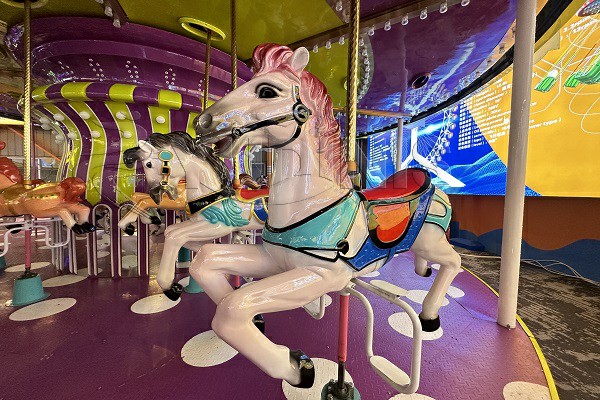
Start with Cycles, Not Seats Alone
The basic ride capacity calculation begins with the number of guests carried per cycle. Multiply usable seats by average occupancy, then multiply that figure by the number of completed cycles in an hour.
Theoretical riders per hour = usable seats × average occupancy × cycles per hour.
This result is the maximum number of riders the attraction could serve if every cycle were completed and every usable seat were occupied. Real operation is normally lower because not every guest group fills every seat and the station may not dispatch at the theoretical interval.
Build the Cycle Time Accurately
A common mistake is to divide the hour by the ride duration alone. That excludes the work needed before the carousel can safely dispatch and the time needed to release and clear the station afterward. For a commercial carousel, the full cycle should include:
- Gates opening and guests entering the platform.
- Seat selection and caregiver assistance.
- Restraint or safety checks required by the operating procedure.
- Final clearance and ride dispatch.
- The ride rotation and controlled stop.
- Restraint release, guest exit, and station reset.
Review the carousel boarding and unloading time with the manufacturer and local operating team. Loading time may change by audience, staffing, event condition, and station design. The correct number for planning is the interval the park can repeat safely under normal operation.
Seat Count Still Matters
| Model size | Capacity effect | What else changes |
|---|---|---|
| 16 seats | Fewer riders available on each cycle | May suit a compact or lower-demand location |
| 24 seats | A middle option for family traffic | Station layout and operating demand need review |
| 36 seats | More potential riders per cycle | Larger platform, queue area, and unloading flow |
A larger carousel does not automatically deliver proportionally more hourly riders. More seats can reduce the number of cycles needed to serve a guest group, but the platform may take longer to load and clear. The full cycle and station design determine the actual advantage.
Account for Occupancy
Occupancy reflects how many available positions are normally filled. It can vary by age group, ride rules, group sizes, and whether adults must accompany younger children. A carousel marketed as a 36-seat ride may not carry 36 riders on every cycle.
Use historic observations when available. For a new attraction, prepare low, expected, and strong assumptions and keep them visible in the capacity model. Do not present a fully loaded cycle as the normal planning figure.
Separate theoretical and achieved capacity
Theoretical capacity is useful for engineering and design reviews. Achieved capacity is more useful for queue planning and financial forecasts. Measure achieved riders over representative operating periods after opening, then compare the result with the original model.
Test Capacity Across the Day
Demand is not constant. School groups, weekends, holidays, evening events, and quiet weekdays may produce different occupancy and queue pressure. A carousel can have enough hourly capacity overall yet still form a long queue during a short peak.
Estimate guests per hour for each relevant day part. Include competitors, weather, opening hours, and the ride’s position in the park. If the queue becomes longer than guests will accept, adding a larger carousel may not solve the problem unless cycle time and station flow improve at the same time.
Review the Station and Guest Flow
Capacity depends on the area around the platform as much as the turning platform itself. Entrances and exits should not cross. Caregivers need waiting space without blocking boarding. Staff need a clear view of seats and gates. Queue rails should support orderly loading rather than create a bottleneck at the gate.
Ask the supplier to provide a layout showing the ride envelope, queue, access routes, and maintenance zones. Review the arrangement with attendants who will manage the ride. Their practical observations can reveal loading problems that are not obvious on a general arrangement drawing.
Compare Hourly Capacity Fairly
When comparing models, use the same occupancy, ride cycle, passenger loading allowance, and station reset assumptions. Ask each proposal to show the calculations and identify whether the figure is theoretical or achievable.
- Confirm the number of usable seats.
- State the average occupancy assumption.
- Record the complete boarding-to-dispatch cycle.
- Calculate theoretical riders per hour.
- Apply a realistic operating efficiency.
- Review capacity during each demand period.
The commercial carousel hourly capacity should not be accepted as a one-line marketing figure. A transparent model lets the operator see which assumption creates the biggest change and which layout improvement is worth pursuing.
Capacity, Reliability, and Maintenance
Available capacity is also affected by downtime. A high theoretical figure is less useful if the ride frequently stops for maintenance. The service plan should identify routine checks, critical spare parts, technician requirements, and the manufacturer’s response process.
Some structural or mechanical components may use Nickel steel where specified by the approved design. Material choice must follow engineering drawings and corrosion-control requirements; operators should not change components based only on a local supplier’s recommendation.
Design for Achievable Flow
A carousel project created with the Dinis commercial carousel team should be reviewed as a complete operating system. Seat count, station width, gates, controls, staffing, and maintenance access all work together. Improving only the platform size without examining the loading route can leave capacity unrealized.
Capacity planning should also include a plan to monitor actual performance. Record riders per operating day and per peak hour, queue length, cycle delays, closures, and staff deployment. That evidence shows whether the ride needs operational changes before capital expansion is considered.
Review the Full Configuration
Send the supplier the expected audience, site plan, opening hours, and target queue tolerance. Ask for a capacity calculation that shows assumptions rather than only a final number. To compare the carousel options and compare layouts, work with an amusement attraction manufacturer that can connect the ride specification to the station and operating plan.
The best answer to “how many riders per hour?” is therefore a range tied to defined assumptions. Compare the range, test it against demand, and revise it after opening with measured data.
Leave a Reply