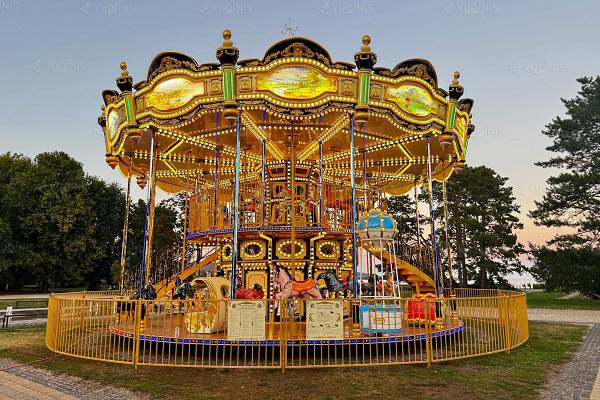
Most large parks reach the same question at some point: should the plaza in the middle of the site hold a classic single-deck carousel, or a taller double-decker that becomes the park’s landmark? The answer changes the capital cost, the load time, the sight lines and the staffing requirement, and it is difficult to reverse once the foundations are in. This comparison looks at what a large carousel for a main plaza should deliver in each configuration.
What the Plaza Actually Needs
Start with the plaza rather than the ride. Measure the open space available on every side, the width of the walkways that feed it, and the number of guests who pass the point in the busiest hour. A carousel is a throughput machine as well as an attraction, so the configuration that matters is the one that can be loaded quickly and seen easily from the main circulation route without blocking it.
Single-Decker Carousels: Capacity and Cost
A single-level carousel with thirty to forty horses is cheaper to buy, cheaper to install and easier to maintain. It loads in one movement, which shortens the interval between rides, and its lower profile keeps sight lines across the plaza open. For parks whose main plaza is also a thoroughfare, that combination is often the better operational choice.
Double-Decker Carousels: Capacity and Presence
A two-level carousel adds seats, height and a sense of occasion. It gives the park a structure that can be seen from the entrance and photographed from every corner of the plaza, and the upper deck gives guests a view over the surrounding area. A larger model such as a 68 seat double decker carousel needs a wider envelope, a stronger foundation and more loading staff, so the capacity gain should be measured against the extra operating cost rather than assumed.
Structural, Power and Access Differences
The two configurations differ in more than appearance. A double-decker carries a heavier rotating mass, needs a larger foundation and usually requires more power and a bigger control enclosure. Access for inspection also changes: the upper deck must be reachable safely for cleaning, lighting maintenance and emergency evacuation. Confirm the bearing loads, the wind exposure and the annual inspection routine before committing to the taller design.
Guest Expectations and Branding
Guests read the two rides differently. A single-deck carousel reads as a family classic; a two-level carousel reads as a landmark and a photograph. Neither is automatically better, but the choice should match the identity the park is marketing. It is worth reviewing the general principles of carousel engineering before the specification is frozen, because the platform, drive and canopy arrangements determine how easily the ride can be themed later.
Comparing the Investment
Compare the options over ten years. Add purchase price, foundation, installation, lighting, staff hours, maintenance and the spare parts each design requires. Then compare revenue more carefully than cost: a double decker carousel for main plaza may carry more riders per cycle while a single-deck ride may complete more cycles per hour, and the winner depends on how quickly your team loads guests. Run both scenarios with your own attendance data.
The right choice for a main plaza is the configuration that matches the space, the staffing model and the park’s identity. Measure the plaza, compare real throughput rather than seat counts, check the structural and power consequences, and match the ride to what guests expect to see. Buyers can compare both arrangements with Carousel Manufacturer factory and review the product at https://www.carouselmanufacturer.com/product/large-carousel-horse-for-sale/.
Leave a Reply