A children’s water park is not simply a water park with smaller slides. It is designed around a different guest: a family with young children, a parent who needs to see the whole play area, and a toddler who spends twenty minutes on one small feature. That changes the equipment mix, the safety planning and the budget.
This article explains what a children’s water park includes and how much it typically costs, with reference to the How much does it cost to build a water park.
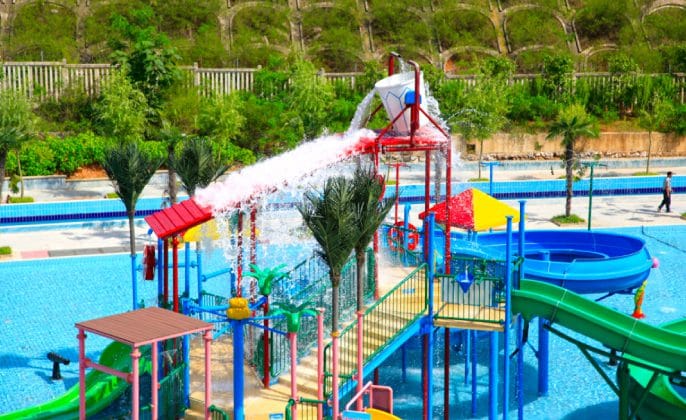
What a Children’s Water Park Includes
- Splash pad with interactive water features
- Shallow paddling pool with soft-play elements
- One or two small slides with gentle gradients
- Shaded seating with clear sightlines to the water
- Changing and family facilities
- Filtration sized for the water volume
The defining feature is not the rides but the supervision. Parents need to see their children from a seated position, and lifeguards need to see every water feature from their station.
Cost Breakdown
| Block | Typical share |
|---|---|
| Splash structures and small slides | 35 – 45% |
| Pools and civil works | 15 – 25% |
| Water treatment and plant | 10 – 18% |
| Changing rooms and shade | 10 – 18% |
| Installation and commissioning | 6 – 12% |
A compact 300 to 1,000 m² children’s water park typically lands between USD 150,000 and 600,000 for the attraction package, plus site works and installation.
Sizing to Families
Size the park for the number of children on a peak afternoon, not for the land available. A family venue with 200 peak-day visitors typically needs 300 to 600 m² of developed water area; a larger resort with 500 visitors needs 800 to 1,200 m².
The water park equipment and attraction costs follow the same pattern as larger parks, but the fixed costs weigh more heavily. That is why small children’s water parks cost more per square metre – and why phasing matters.
Safety and Supervision
Children’s water play needs more supervision than adult pools. Plan lifeguard positions so that every feature is visible, and separate the toddler area from the slide landing zone. Non-slip surfaces, rounded edges and shallow depths matter more than any single feature.
Materials should be easy to clean and resistant to chlorine and UV. Moulded Polyethylene and fibreglass components are common because they are durable and have no sharp edges.
Site Works and Plant
Water treatment must be sized for the splash pad and pool volume. A water park construction budget guide should include the plant room, not just the play structures, because retrofitting filtration is expensive.
Drainage is critical on a splash pad. Water must leave the play surface quickly to prevent slips, and the surrounding deck should fall away from the play area.
Phasing
A children’s water park can open in two stages: the splash pad first, then the paddling pool and slides. The splash pad delivers immediate family appeal at a lower cost and tests demand before the larger commitment.
What Drives the Cost Up or Down
The biggest swing is the water area. Doubling the splash pad adds equipment, decking and filtration together, so the cost does not scale linearly – it jumps. The second is the level of theming: a themed play structure with custom features costs more than a standard unit.
Site conditions matter too. A flat, drained site is cheap to develop; a sloped site needs retaining walls and a pumped drainage solution. And if the existing building has no spare plant capacity, the upgrade can add 20 to 30 percent to the project.
Operations for a Children’s Park
Staffing is the main recurring cost. A children’s water park needs lifeguards with child-specific training, and coverage must be continuous while any water feature is open. Plan the roster around the number of water bodies, not the number of guests.
Cleaning and water testing also take more time than at an adult pool, because young children are more sensitive to water quality. Budget for chemicals and staff hours accordingly.
Common Mistakes in Children’s Water Park Projects
The most common mistake is copying a general water park and shrinking it. That produces deep water, tall slides and seating that cannot see the play area. The second is under-sizing changing facilities, which becomes obvious on the first busy weekend. The third is skipping shade, which shortens visits and reduces satisfaction.
Design the park around a parent sitting with a coffee while watching two children in different features. That single picture resolves most of the layout questions.
A final note: children’s water parks attract repeat local visitors, so the design should be easy to refresh. Replaceable play panels and a theming system that can change each season keep the park interesting without rebuilding it.
Frequently Asked Questions
How much does a children’s water park cost?
A 300 to 1,000 m² scheme typically requires USD 150,000 to 600,000 for the attraction package, plus site works and installation.
What is the minimum size?
A splash pad of 150 to 300 m² can work as a standalone amenity; a full children’s water park needs roughly 300 m² or more.
Can it be indoor?
Yes. Indoor children’s water parks extend the season but add building, ventilation and heating costs.
Next Step
Send us the venue type, expected family attendance and site area, and we will propose a layout. Our Dinis park engineering can supply splash structures and small slides, and as a park equipment manufacturer we can advise on site works. For the full cost detail, open the full article.
Leave a Reply